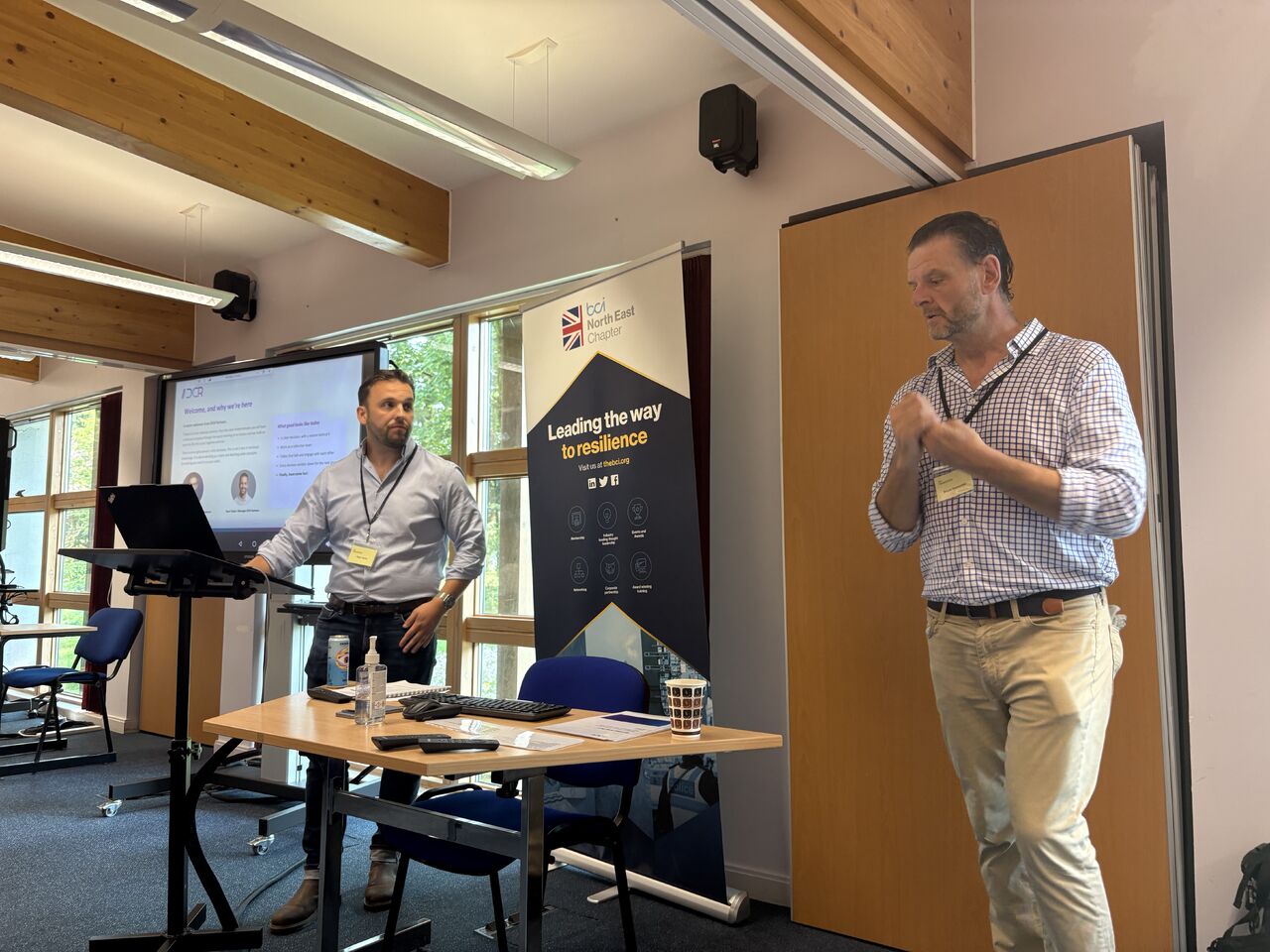
Last week, Bryan Hurcombe and Ryan Taylor from the DCR team spent a scorching day at The Hawkhills, home of the UK Resilience Academy just outside York, running a complex crisis exercise for The BCI North-East Chapter. It hit 35 degrees. Bryan rode in on his motorbike, which tells you something about his commitment to the cause, or possibly that he hadn't checked the forecast.
The Scenario
Around 29 business continuity professionals took part. Bryan and Ryan put them inside a fictional company, a UK-listed precision engineering and defence manufacturer, and handed it the worst morning in its history. Two crises landed at once:
- A supply chain coming apart on three fronts
- The discovery that one of its engineers had spent months feeding sensitive, export-controlled specifications into a commercial AI tool, with no policy in place to stop them
The press was about to run the story.
It is the sort of morning that no plan fully prepares you for, which is rather the point of running these. You can read a plan all you like, but you only really test it by sitting in the room with half the facts missing, the clock running and several people wanting an answer at once. An exercise is where you find the gaps, and feel that pressure, while none of it is real.
The Exercise
What made this one work was splitting the room across four tables, each handling the same crisis from a different level:
- The Board worked the governance and disclosure questions, and whether the company was still in any sort of control
- Gold took the big strategic calls
- Silver worked out what could still be delivered and what was now broken
- Comms decided what staff, the public and the press were told, and in what order
The catch was that no table had everything it needed. The Board could not settle a disclosure line without Gold's numbers, and Comms could not say anything until the Board had landed its position. The only way to pass information was the Link, one person per table carrying messages across the room by hand, which is much closer to how things move in a real crisis. Halfway through, the groups moved tables and picked up whatever decisions the previous group had left behind.
The Takeaway
The thing people kept coming back to was how little of this had to do with technical knowledge. It was about whether a table made a decision, and whether it talked to the rest of the room. That is the part you can only learn by doing it, and it was a pleasure to watch people work it out as the morning went on.
A few things that stood out:
- Crises rarely arrive one at a time, and plans need to hold up under more than one pressure at once
- Decision-making under pressure matters more than technical know-how when the clock is running
- Communication between teams, not just within them, is often where a response succeeds or fails
- Information bottlenecks (like the Link) mirror how real crises actually unfold, and are worth exercising deliberately
- Rotating people across roles halfway through builds empathy for what the other tables are dealing with
Closing Thoughts
Days like this are a reminder that resilience is as much about people and decision-making as it is about plans on paper.
A big thanks to The BCI for having us, and to everyone who got stuck into a difficult and fast-moving session with absolute enthusiasm. It is the kind of energy that makes these exercises worthwhile, and we hope everyone left with something to take back to their own organisations.
Find Your Gaps Before a Real Crisis Does
We design and run tailored crisis exercises like this one for organisations who want to stress-test their plans in a room, not just on paper. If that's something you're considering, get in touch and we can talk through what it might look like for your team.